
As Kenyans commemorate Saba Saba, we honor the courageous women and men of the Second Liberation whose sacrifices paved the way for constitutionalism, human rights, and accountable governance. Saba Saba is a living reminder that constitutional democracy demands constant vigilance, as the freedoms guaranteed under the 2010 Constitution were secured through decades of struggle against authoritarian rule.
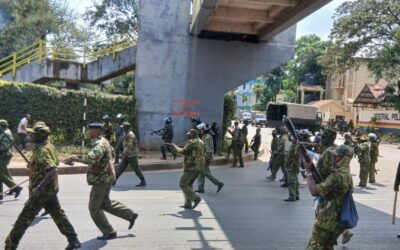
Today, this democratic legacy faces increasing strain from political intolerance, a shrinking civic space, and growing insecurity surrounding civic action. There are persistent reports and observations of state-sponsored goons disrupting peaceful gatherings and attacking citizens, often in the presence of security officers who fail to intervene, as witnessed recently during the Linda Mwanachi rally in Kisii and the blockade of Thika Road.
Kenya’s current trajectory mirrors documented patterns of democratic backsliding seen elsewhere on the continent, such as the use of unmarked vans, reminiscent of Uganda’s “drones”, to snatch civic and political activists. Furthermore, the evolution of specialized units operating with off-book funding reflects the Nigerian “SARS” model, which previously led to civilian uprisings against police impunity.
Equally disturbing is the increasing resort to serious national security charges, including allegations of treason and terrorism, against civic actors, protest leaders, and government critics. While states have a legitimate obligation to investigate and prosecute genuine threats to national security, the selective and disproportionate use of such charges risks creating the perception that the criminal justice system is being instrumentalized to suppress political dissent rather than to uphold the rule of law. Across the region, the securitization of civic engagement has become an increasingly common feature of democratic regression, shrinking civic space and weakening constitutional guarantees of freedom of expression, association, and peaceful assembly.
We are deeply alarmed by the “strategic linguistic shift” introduced by Interior PS Raymond Omollo, who has dismissed reports of state-led disappearances as “purported abductions”. By reframing these cases as “missing persons” issues, the state effectively shifts the burden of proof onto traumatized families and uses the “color of law” to frustrate accountability. This tactic seeks to insulate the state from litigation while maintaining an international facade of rule-of-law compliance.
A constitutional democracy cannot function where citizens fear exercising rights guaranteed under Article 37, which protects the right to assemble, demonstrate, and picket. We condemn all forms of enforced disappearances, incommunicado detention, excessive force, and protest-related deaths, all of which demand prompt, independent, and transparent investigations.
We therefore call for:
- Immediate, independent investigations into all cases of enforced disappearances, torture, and excessive use of force.
- A comprehensive inquiry into organized political violence and the use of criminal gangs to intimidate citizens.
- Professional, impartial policing that is fully accountable to civilian oversight institutions and the courts.
- The strengthening of independent oversight bodies, including the Judiciary, Parliament, and constitutional commissions.
- A renewed national dialogue grounded in constitutional values and inclusion.
The history of Saba Saba teaches us that democracy cannot survive where fear replaces freedom and where violence becomes an instrument of political competition. The struggle to restore the dignity of the Kenyan people and limit arbitrary state power continues today. Defending the Constitution is not an act of opposition; it is an act of patriotism.
Dr. Kawive Wambua
Chief Executive Officer
Inuka Kenya Ni Sisi!