
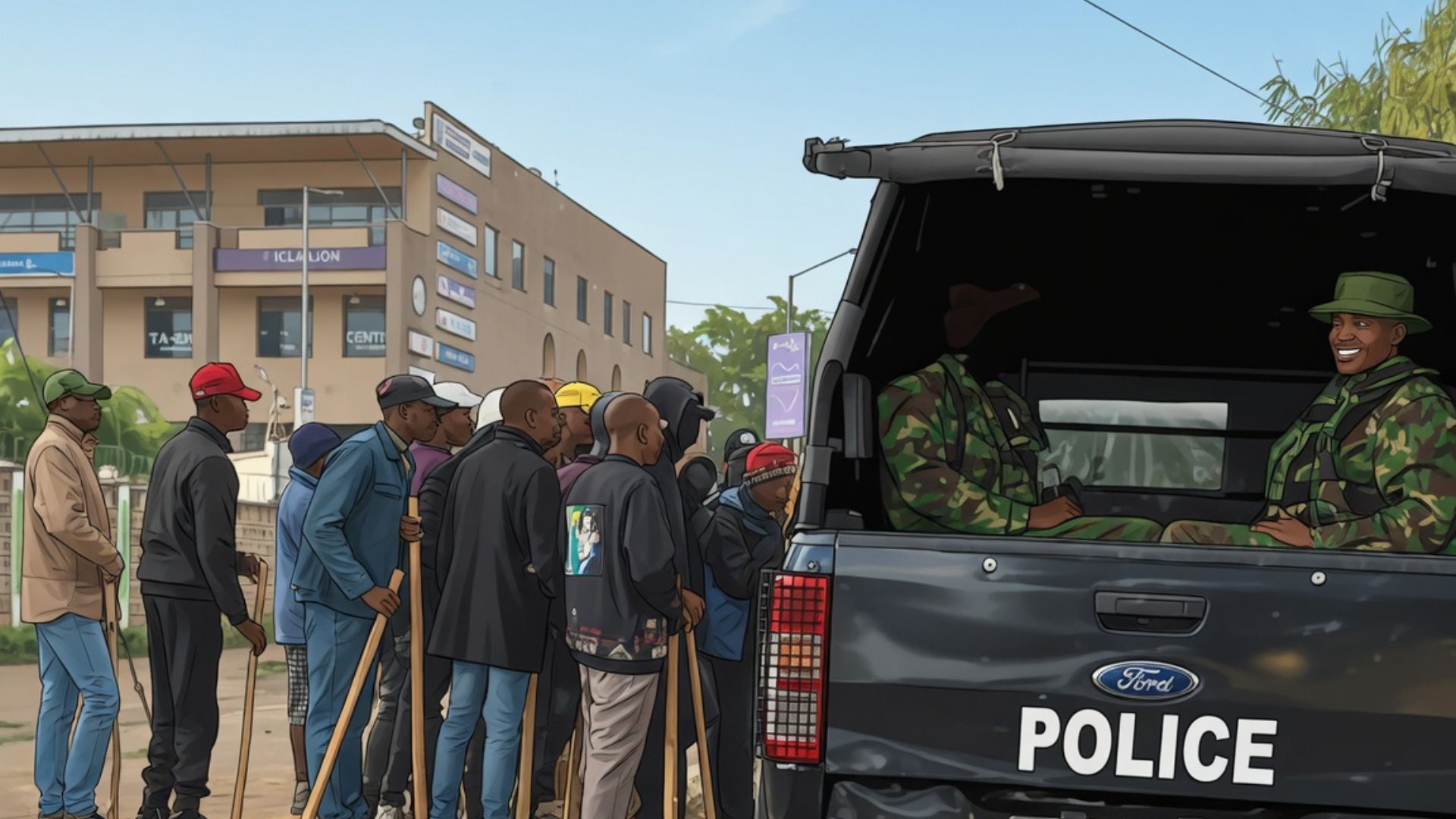
Back then, chaos at political rallies felt accidental, like the natural overflow of charged emotions, rival chants, and overcrowded spaces. If stones were thrown or fights broke out, we blamed tension, misunderstanding, or “rowdy youth.”
But not anymore.
Today, there’s a pattern. Predictable. Timed. Almost rehearsed.
There’s a moment, just before chaos, that every seasoned political rally attendee in Kenya has learned to recognize. The music is still playing. The crowd is chanting. A politician is mid-sentence, promising roads, jobs, dignity.
Then, almost on cue, the mood shifts.
A group appears from the edge of the crowd. Not supporters. Not opponents. Something else. Coordinated. Intentional. Armed, not always with guns, but with stones, knives, rungus, and a kind of rehearsed aggression.
Within minutes, the rally is no longer a rally. It is a battlefield.
We saw it recently in Kikuyu, during a rally linked to Rigathi Gachagua. What began as a political gathering quickly spiraled into confrontation, stones hurled, crowds scattering, tension thick in the air. It did not feel random. It felt orchestrated. The kind of disruption that arrives too precisely to be a coincidence.
Increasingly, such incidents occur either in the visible presence of police alongside civilian gangs, or in their conspicuous absence, leaving ordinary citizens exposed and terrorised for hours without protection or recourse.
And if that scene felt familiar, it’s because we have seen it before, on the streets during the Gen Z protests.
Thousands of young people showed up demanding accountability and justice. Their energy was raw, their message clear. But within those crowds, another group moved differently. While protesters chanted, they provoked. While others held placards, they threw stones. Shops were looted. Fires lit.
And just like that, the story changed.
From peaceful protest to “violent unrest.”
The question many asked then still lingers now: who were they?
Because whether in rallies or protests, the pattern is hard to ignore. Goonism is no longer a background tactic; it is becoming a visible political tool. Deployed to disrupt, to discredit, and to control.
And at the center of it all is the Kenyan youth.
A young man leaves his house with no job and no plan for the day. By noon, he has been offered money to “show up.” By evening, he is in the middle of a confrontation, fighting people he has nothing against, defending leaders he may not even support. Not out of loyalty, but out of necessity. Worst case scenario, the goons maim, destroy property, or even kill or get killed if they are cornered.
That is how goonism sustains itself, not just through politics, but through poverty.
What is most dangerous is how normal it is starting to feel. We are no longer shocked when rallies turn violent. We expect it. We brace for it. We move with caution, scanning crowds for the first sign of disruption.
And in that normalization, something deeper is being lost.
The erosion of democracy, disregard for the sanctity of human life, and the breakdown of law and order are critical warning signs of a state in distress or a failing state.
Because when rallies are controlled by hired groups and protests are diluted by planted chaos, public participation becomes a risk. Voices are drowned out. Fear replaces engagement.
The ordinary Kenyan, the one who came to listen, to question, to belong, becomes collateral.
As the country slowly moves toward the next election cycle, the warning signs are already here. Visible. Repeating. Ignored at our own risk.
So the next time chaos erupts, don’t just ask what happened.
Ask who needed it to happen.
Because behind every flying stone, every disrupted rally, every sudden shift from peace to panic, there is intention.
Kenya cannot continue to call itself a democracy if political outcomes are forged through violence, coercion, and repression rather than genuine public participation. A legitimate democratic system must be driven by the free, diverse, and unfiltered voices of its people, not manipulated through fear, force, or elite control.